Triggered
by Nobuyoshi Araki ‘s artwork being
shown in London, the article presents a debate about the boundaries and limits
between art and pornography, related to
photography and the Japanese culture. Araki’s work has been criticized before,
for it’s not so explicit yet loud and even called “degrading” photographs, in a
previous show that took place in Australia, in 1992. His views on photography
and the controversy around pornography,
reveal a yet unsolved discussion about
the limits of art.
Michael Hoppen,
in a review of Araki’s artwork, attempts to find answers for this unsolved
discussion, and also, consider the cultural background as a part of Nobuyoshi’s
photographs, by linking his artwork to traditional shunga Japanese woodblock prints. Araki’s work is not as graphic as these
traditional prints, but it is clear that by the 1990’s, the sexually explicit pictures
and their connection to the representation of the Japanese society and
traditions, was shocking enough to bring this discussion out.
Araki states
that his artwork is directly related to life itself. He claims his work is a
representation of the everyday life, but most important, that the line between
pornography and art, is not meant to be settled up. They are not, necessarily, two different subjects,
and art can take any form or matter, and turn it into a piece worth to be seen.
Araki, although criticized, has been able to
make art out of the discussion about art and porn itself, and , in the words of
Simon Baker; “t's an incredibly polite,
formal society on the surface, [but it] has this hidden underside of sexuality.
Araki very effectively works on this relationship."
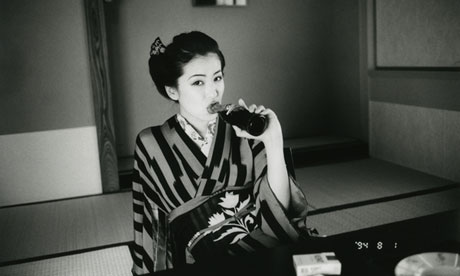
Seedy yet sophisticated … a shot from Nobuyoshi Araki's book,
Grand Diary of a Photo-Maniac (1994/2013), published by Taschen.

Courious. I can't come up with something to comment, but the article seems interesnting. Think I'm gonna read it.
ResponderEliminar